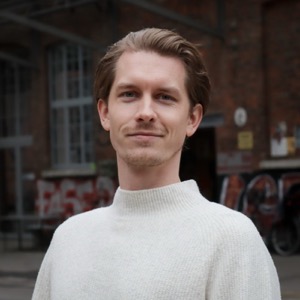
I am human
I grew up in a small town in southern Germany. Working-class family. Swabian work ethic. The kind of upbringing where your worth is measured by how hard you hustle.
From my mother, I learned — without either of us realizing it — that I wasn't quite enough. Not in a cruel way. In a quiet way. Different love languages, I'd understand much later. But the feeling settled in early: you need to prove yourself. Constantly.
From my stepfather and the German Red Cross, I learned something else: the impulse to help. I was eight or nine, pouring cola for blood donors. That was my first contact with the idea that you could just… show up for other people.
The pattern
I studied business. Got the best grades. Gave the valedictorian speech. And then discovered that everything I'd learned brought me absolutely nothing on the street.
What followed was a decade-long cycle: get a job, learn fast, burn out, feel purposeless, pull haelp out of the drawer, pour everything into it, burn out again, put it back, get another job. Repeat.
Almost all of my ideas circled around the same thing: social connection. Creating spaces for encounter. Making invisible labor visible. Building infrastructure for people to help each other.
I just couldn't find the right shape.
The iterations
Cambodia, 2016. A Buddhist monk blessed me with a red bracelet. I wanted to fund clean water wells through social impact tracking — bracelets with codes that connected you to the well your purchase funded. This is when I learned to code.
Social impact goods. The TOMS model but better — sustainable, inclusive, traceable. The requirements list grew impossibly long. Nothing shipped.
Crypto and basic income. A Bitcoin millionaire wanted to fund impact projects. For 1.5 years I could build full-time. I over-engineered everything. The market crashed. I nearly went bankrupt.
Mutual aid network. An app for volunteering — you open it, see needs around you, help out, it goes into your Impact Wallet. Making care work visible. Beautiful idea. Never shipped.
Every iteration taught me something. Every failure stripped away one more layer of what haelp was not.
The beach
Tenerife, 2025. I was sitting on a beach. Surrounded by people. Families, couples, solo travelers. Dozens of humans within arm's reach.
And I felt profoundly, structurally alone.
Not lonely in the self-pity sense. Lonely in the systemic sense. I looked around and thought: we're all here. We are all human. But we don't see each other — even though we're literally sitting side by side.
There is no protocol. No gesture. No signal. No invitation for telling a stranger: I'm open to connecting.
That's when everything collapsed into clarity. Not an economy. Not a platform. Not a mutual aid system. Just this: two humans seeing each other.
The real breakthrough
A few days before writing this, I had a conversation that changed everything. Not with a human — with an AI. (The irony is not lost on me.)
I asked: What if haelp has always been a therapy for myself? What if it doesn't need to be built? What if this acknowledgement is not between strangers — but me acknowledging myself?
The response: "That's not crazy. That might be the most important thing you've said. Sit with it for a second."
I sat with it. And something shifted — not intellectually, but in my body. The tension I'd carried for decades, the constant performing, the room-reading, the people-pleasing, the 150% that was never enough.
For the first time, I didn't need someone else to tell me I was enough.
That's not a confession. That's the foundation. Because I can only build something this honest if I've stopped pretending.
What haelp is now
haelp is a living lab for humanity. It's the container I've been looking for — big enough to hold every experiment, every format, every question that has ever lived inside me.
The Human Acknowledgement Protocol is experiment #1. But it's not the last. There will be workshops, conversations, guerrilla actions, content, community events, guided practices. Things I haven't imagined yet.
The theme is permanent: what it means to be human. Individual experiments can fail without destroying the mission. That's the freedom I've given myself.
I'm not building a startup. I'm lighting a campfire on the moon and trusting that the right people will make the journey.
Why I need you
I'm currently a partner at an AI consulting firm. I'm good at it. It pays well. And every day I feel it: this is not where my life's energy is supposed to go.
I want to dedicate myself fully to this. To this lab. To this question. To this fire.
If my story resonates — not as entertainment, but as something you recognize in yourself — then maybe you're one of the humans who makes this possible.
Become a Founding Human →